


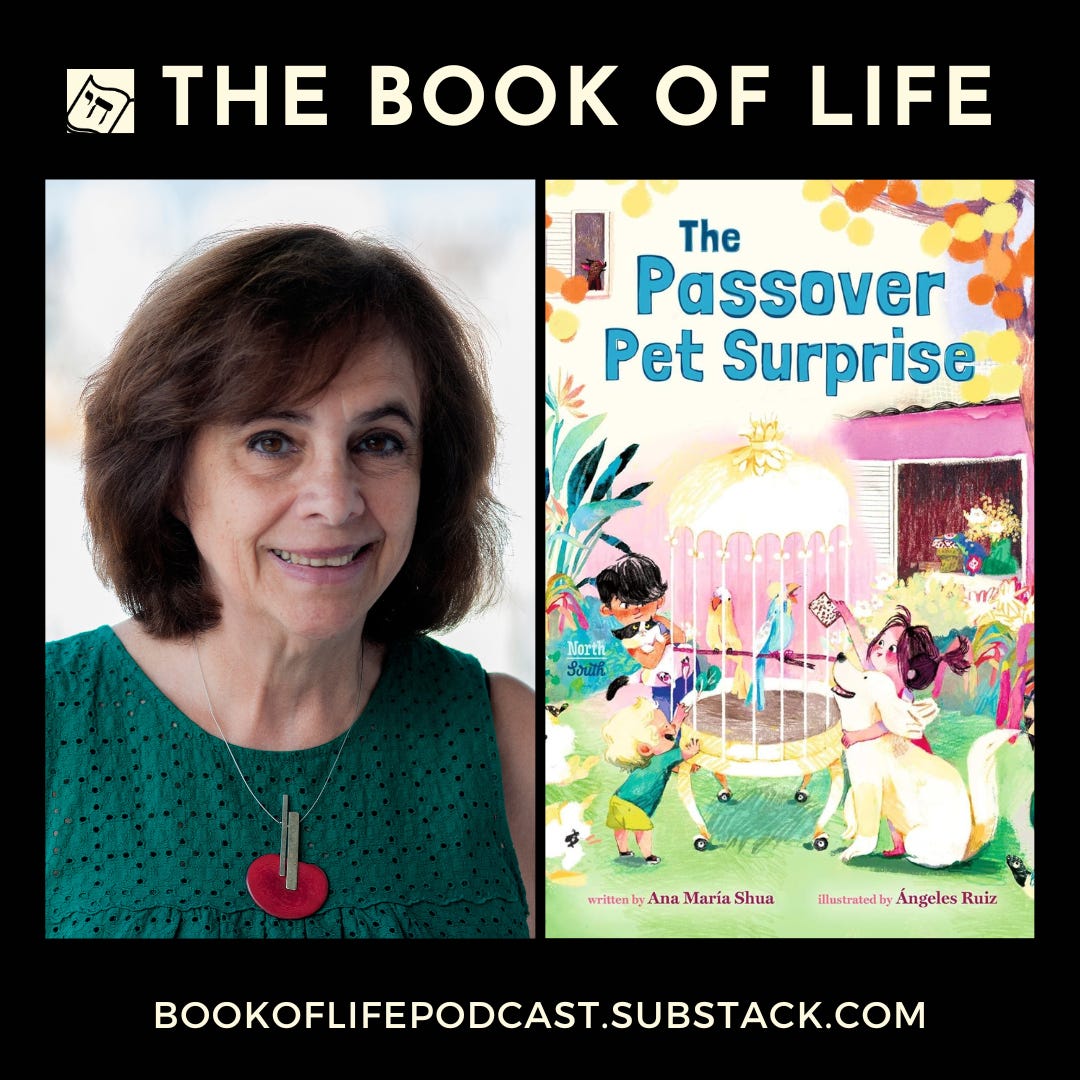
The Passover Pet Surprise really did surprise me. This emotionally authentic story by Argentine author Ana María Shua ends ambiguously, challenging expectations in a way that feels like real life. It’s intriguing, and I question whether that would happen in a story written by a North American author. I also love the candy-colored illustrations by Ángeles Ruiz, which are full of surprising details that convey how thrilled the family is to celebrate together. Look at the way Mamá and Aunt Verónica lean in, cheek to cheek, while making matzah balls, or how Papá puts his hand on Uncle Ariel’s shoulder as they stand at the grill. The tortuga pequena opening wide to bite into a strawberry made me laugh aloud — I used to have a red footed tortoise who ate in just the same way. All this is to say, this book rises beyond a simple story about a seder. It is both familiar and it raises questions, perfect for a holiday where we are commanded both to retell and to inquire.
Love, Heidi
NEWS
Here’s a School Library Journal article about the film The Librarians, “The Librarians Director: I see the film as a movement.” READ HERE
Have you seen the #ThisIsWho trend sweeping across social media? It’s adorable: people post childhood photos labeled with their grownup roles. Look at this example from recent Book of Life guest Suzy Ultman HERE, and see a #ThisIsWho picture of little Heidi HERE.
CALLS TO ACTION
“Judy Blume: A Life, with Author Mark Oppenheimer” online, Wednesday, April 15, 11AM-12PM ET, ticket price $15 for non-members of Long Island Library Resources Council. REGISTER HERE
Temple Israel in West Bloomfield, MI recently suffered an antisemitic attack (Jewish Book Garden post HERE: “Books to Process Synagogue Attack News”). Donate to their emergency fund at temple-israel.org.
SHOW NOTES
Author Ana María Shua’s website (in Spanish)
Illustrator Ángeles Ruiz’s website
Read Heidi’s review of The Passover Pet Surprise on The Jewish Book Garden
Tikkun Olam suggestion: support Magen David Adom
TRANSCRIPT
Ana Maria Shua 0:00
[COLD OPEN] My grandparents on my father’s side, they were religious, but my father, he was absolutely against religion. My whole Jewish education when I was a child was the picture The Ten Commandments with Charlton Heston! [LAUGHTER]
Heidi Rabinowitz 0:19
[MUSIC, INTRO] This is The Book of Life, a podcast about Jewish kidlit. I’m Heidi Rabinowitz. Ana María Shua is an award winning Argentine author who has published over 100 books, including poetry, drama novels, science fiction, children’s literature, film scripts, short stories and microfiction or flash fiction. She is one of the foremost writers in Latin America, where she’s known as the Queen of the Micro Story. So obviously she’s a really big deal... and yet I was not aware of her until I read her first Jewish children’s book, The Passover Pet Surprise, also available in Spanish as La gran sorpresa de Pésaj. This emotionally realistic picture book with its joyful candy colored illustrations by Spanish artist Ángeles Ruiz, is about a little girl who misunderstands the meaning of the festival of freedom... or does she? You can find show notes, a transcript and bonus content at BookOfLifePodcast.substack.com and if you’d like to hear Ana María Shua’s Share Your Shelf segment, click on “Upgrade to paid.” Thanks and happy Passover. [END MUSIC]
Heidi Rabinowitz 1:47
Ana María, you have published over 180 books in various genres, but I must admit that until recently, I was not familiar with your work. Other than The Passover Pet Surprise, are many of your books available in English?
Ana Maria Shua 2:05
Yes, but not my children’s book. Five of my novels have been published in English in the United States, published by university presses and small publishers.
Heidi Rabinowitz 2:18
I’m glad to have a chance to learn more about your work and introduce it to more English speakers. Tell us about The Passover Pet Surprise, and what was the inspiration for this story?
Ana Maria Shua 2:31
Well, an editor asked me to write a Jewish Latin American story. And I love Pesah. I think Passover is the best of all Jewish holidays, because it’s not only for Jewish people, it’s for the whole world as a celebration of freedom for everyone. In this story, this little girl, she knows about Passover and freedom, and she decides to open a bird cage to let the birds be free, two little parrots. I thought that could be the center of the story, the core of the story, the structure. And all around this little idea is about how we celebrate Passover in Argentina. The story happens in a city called Mendoza in the north of Argentina. There’s a family who is split apart. Part of the family lives in the United States, in Miami, and the other part lives in Argentina.
Ana Maria Shua 3:37
A lot of the ideas came to my mind because my own family is split apart. On my mother’s side, my grandfather came from Poland to Argentina. I’m, you know, half and half: Sephardic and Ashkenazi. His six siblings went to the United States, and they have children, and the children grew up, and they have children. So I have a really huge family in the United States. Then many years after that, when the last terrible and bloody dictatorship took Argentina, my own sister had to escape from our country, and she went to live not far from Chicago in Evanston with her husband, who is Argentinian too, and they have children. And the children have children. They come to visit us in Argentina. So it was not difficult for me to think about part of the family in Miami and part in Mendoza, and the family in Miami comes to Mendoza to Argentina to spend Passover with the rest of the family. And there comes Jordanita.
Heidi Rabinowitz 4:54
So many of the book reviews that I have read say the book explores the meaning of freedom. Jordanita hears the story at the seder about the importance of freedom, so she frees her aunt’s parrots from their cage, and she wants them to be free, but she doesn’t understand that releasing pets Into the wild might not be safe for them. So what IS the meaning of freedom that you were trying to convey in this story?
Ana Maria Shua 5:24
That’s a difficult question. I mean, are we free after all? Who is really free? But you know, I’m sure the little parrots will be more free if the cage is open. That is what Jordanita thought about, that’s all. I mean, after she did it, she is really worried about what could happen to those little parrots, because they have lived their lives always in cages. So are they going to be able to find food for themselves? Well, who knows? I think they will. I think they will be able. Of course, there are lots of little parrots in Mendoza, so they’re going to find a lot of friends and family. [LAUGHTER]
Heidi Rabinowitz 6:21
Well, that’s reassuring.
Ana Maria Shua 6:24
Yes, and they will be free.
Heidi Rabinowitz 6:26
Well, it’s interesting because the story ends without telling us what happens to the parrots. The parrots are loose, and we never see them again. So we don’t actually know if they’re okay or not, but I’m glad you think that they are. [LAUGHTER]
Ana Maria Shua 6:39
I think they are, yes, but we really don’t know. The book is ambiguous if Jordanita was right or wrong, and the adults are not sure about if it’s okay or not. They don’t know if she should be punished for what she had done. I think maybe that’s what I really want, when people read my books, to make themselves question, because I don’t have the answers. I have a lot of questions. And I think good literature is about questions and not about answers.
Heidi Rabinowitz 7:16
And that’s perfect for Passover, to have lots of questions!
Ana Maria Shua 7:20
Yes.
Heidi Rabinowitz 7:22
What is your favorite thing about Passover?
Ana Maria Shua 7:26
I just love Passover. My favorite thing is the way the whole Jewish people, everyone could find inside the guts to leave Egypt and go into the desert, who knows where, just to be free. That’s really courageous. And I admire, I absolutely admire that decision.
Heidi Rabinowitz 7:54
I love that. Thank you. The family in the book has many pets. They have dogs, a cat, turtles, the parrots, and Jordanita’s family only has tropical fish. That’s why she’s so excited to go to visit her relatives who have so many fun pets. Did you grow up with many pets? Or do you have any pets now?
Ana Maria Shua 8:14
No, I wanted them, but I only had turtles, which I couldn’t have today because it’s forbidden. You can’t buy a turtle. I mean, you can adopt a turtle, but you have to have, you know, garden and green and a lot of things that I do not have because I live in an apartment, so I couldn’t have today a turtle, but when I was little, yes, I had a turtle and a caged bird, a canary, and that was all. I wanted, a cat or a dog.
Heidi Rabinowitz 8:51
So in the book, you fulfilled that wish.
Ana Maria Shua 8:54
Yes. And when my girls were little, we had two cats, not at the same time, but one and then the other one, and we had turtles too.
Heidi Rabinowitz 9:07
What do you think of the art by Ángeles Ruiz? Do you have a favorite illustration?
Ana Maria Shua 9:13
It’s lovely. I really love the Aunt, Aunt Verónica, with all that black hair all over. It’s really lovely. That character is my favorite.
Heidi Rabinowitz 9:27
Yeah, everybody’s hair has a life of its own in these illustrations.
Ana Maria Shua 9:32
Mm-hmm, that’s true. Yes.
Heidi Rabinowitz 9:33
Yeah, especially Papá and the uncle. I’ll tell you, my favorite is the page where they’re getting ready for the seder.
Ana Maria Shua 9:43
Uh-huh.
Heidi Rabinowitz 9:44
And Papá and Uncle Ariel are roasting meat on the grill. Mamá and Aunt Verónica are making knéidalaj. I just like how they look so excited to see each other, just like when you go on a visit you haven’t seen people in a long time, and you’re so thrilled to be together, they just look so happy and affectionate. I really love that illustration.
Ana Maria Shua 10:09
And I love the illustration where the children are playing with the hose, water sparkling all over.
Heidi Rabinowitz 10:17
Mm-hmm, with their bathing suits in the yard.
Ana Maria Shua 10:20
In the yard, yes.
Heidi Rabinowitz 10:21
Yeah. It has a lot of very realistic touches. The book was also released in the US in Spanish as La gran sorpresa de Pésaj. Did you write the book originally in Spanish or in English?
Ana Maria Shua 10:36
I wrote it in Spanish, of course. It was translated.
Heidi Rabinowitz 10:41
I didn’t see a translator’s name on the English edition that I read.
Ana Maria Shua 10:45
Yes, somebody did it. I don’t know who it is.
Heidi Rabinowitz 10:48
Maybe it’s because it’s a review copy. Maybe the final copy will say, but that’s interesting that it didn’t have the name on it. Will you be publishing more books in English, or do you have other Jewish children’s books that can be translated?
Ana Maria Shua 11:02
This is my first Jewish children’s book, except for a book about the wise men of Chelm, which I think is not only a children’s book, children and adults.
Heidi Rabinowitz 11:15
This children’s book demonstrates just one of your many talents. You have published poetry, drama, novels, children’s books, film scripts, short stories, and microfiction. And I’m especially intrigued by that last one, can you explain what microfiction is?
Ana Maria Shua 11:35
Yes, I love microfiction. In Spain, they call me the queen of the microfiction.
Heidi Rabinowitz 11:40
Ah, mazel tov!
Ana Maria Shua 11:41
[LAUGHTER] Yes! In English, I think today it’s called flash fiction. You have a very, very famous author who writes flash fiction, Lydia Davis, she had a Pulitzer Prize.
Heidi Rabinowitz 11:55
Okay, so explain what it is.
Ana Maria Shua 11:57
It’s very simple. It’s just very short stories. One page is the maximum, about 300 words, and there is no minimum. There is even one flash story by Guillermo Samperio (he was a good friend, a Mexican author), called The Ghost, and the rest of the page is blank.
Heidi Rabinowitz 12:19
Oh, wow!
Ana Maria Shua 12:20
White, yes, that’s The Ghost. [LAUGHTER]
Heidi Rabinowitz 12:23
Amazing. So what do you like about that type of writing?
Ana Maria Shua 12:29
Well, I like everything. I think I love to express the maximum possible meaning in the minimum amount of words. I think that texts like The Ghost are only games. I expect more from literature, and I hope my own microfictions surpass that one.
Heidi Rabinowitz 12:54
Could you tell us a little bit about what it’s like to be Jewish in Argentina?
Ana Maria Shua 12:59
We have a very large Jewish community in Argentina, the largest in Latin America. I think we are very few, if we compare with the Jews in the United States, but we are quite a lot comparing to the rest of the continent. I feel we don’t have too much antisemitism in Argentina. I went to a public school, I went to public high school, I went to public university, and I really never felt any kind of discrimination because of being a Jew. One of my daughters, she’s really committed with the community. And she came to me the other day and she said, Mom, I think we have a very good thing about Argentina, because I was wearing today a t shirt that said, “I love Israel” the whole day, from morning to night, and I took a bus and the subway, and I walked in the streets, and nobody said nothing about it, so this is a good thing about Argentina.
Heidi Rabinowitz 14:13
Yeah, that’s amazing, because right now in the United States, if you wore a shirt like that all day, you would definitely get some pushback.
Ana Maria Shua 14:21
Yes, yes, and it’s happening in Europe too. But of course, we do have antisemitism, just like every other place. There’s a saying: What is the Jew? A Jew is someone that is a little bit less antisemitic than all the rest.
Speaker 1 14:39
[LAUGHTER] Oh, my goodness!
Heidi Rabinowitz 14:44
It’s tikkun olam time. What action would you like to call listeners to take to help heal the world?
Ana Maria Shua 14:54
If someone wants to support an institution, I recommend Magen David Adom, which is the Israeli Red Cross. Magen David Adom. I think it’s very important that when people think of improving the world for the whole humanity, they shouldn’t forget the people who are close to them, because being gentle and good and kind to your friends and family, that’s tikkun olam too.
Heidi Rabinowitz 15:31
Okay, two good recommendations, thank you. What are you working on next?
Ana Maria Shua 15:37
Children’s books, I think. I wrote six adult novels, and I would like to write another one, but I’m not sure I’ll be able to do it, because I’m going to be 75 years old in April.
Heidi Rabinowitz 15:51
Oh, mazel tov!
Ana Maria Shua 15:52
Yes, thank you. But it’s not my best creative time.
Heidi Rabinowitz 15:59
Where can listeners learn more about your work?
Ana Maria Shua 16:02
I do have a website. Yes. AnaMariaShua.com.ar.
Heidi Rabinowitz 16:06
AR for Argentina.
Ana Maria Shua 16:09
AR for Argentina. Yes.
Heidi Rabinowitz 16:12
Is there anything else that you want to talk about that I haven’t thought to ask you?
Ana Maria Shua 16:18
Well, maybe I could talk a little bit about how I never had a Jewish education when I was a child, because my father was strongly atheist. He was against religion in a very, very strong way. My grandparents, on my father’s side, they were religious, but my father, he was absolutely against religion, and he didn’t want his daughters to learn anything about the Jewish tradition, because he was afraid that could be, you know, like a base to drag them into religion. So we didn’t have... absolutely no Jewish education. My whole Jewish education when I was a child was the picture The Ten Commandments with Charlton Heston.
Heidi Rabinowitz 17:12
[LAUGHTER] Oh, my goodness.
Ana Maria Shua 17:16
You know, it took me many years. I mean, one of my grandfathers is called Mojżesz. Mojżesz was from Poland, the other one was from Lebanon, and he was called Musa. And it took me many, many years, I discovered they were both called Moses. Mojżesz and Musa, they were so different for me.
Heidi Rabinowitz 17:42
Ana María Shua, thank you so much for speaking with me and happy Passover!
Ana Maria Shua 17:48
Thank you and happy Passover for you.
Richard Ho 17:50
[MUSIC, DEDICATION] Hi, my name is Richard Ho. I’m the author of A Flame Burns On.
Alison Goldberg 17:57
My name is Alison Goldberg. I’m the author of The Remembering Candle. We’ll be joining you soon on The Book of Life podcast.
Richard Ho 18:06
We’d like to dedicate our episode to anybody who’s celebrating the memory of a loved one, or to any parents or educators who are trying to help a child through a loss.
Alison Goldberg 18:15
If you are remembering someone, we hope your memories bring you comfort. May their memory be a blessing. [END DEDICATION]
Heidi Rabinowitz 18:30
[MUSIC, OUTRO] Say hi to Heidi at 561-206-2473, or bookoflifepodcast@gmail.com. I’d love to hear from you! Subscribe for free to BookOfLifePodcast.Substack.com to get show notes, transcripts, Jewish kidlit news and calls to action right in your inbox. If you’d like to receive the bonus Share Your Shelf segments, you can upgrade to a paid subscription. The Book of Life is also on Facebook, Instagram, YouTube, and our 20-year back catalog is online at BookOfLifePodcast.com. Want to read the books featured on the show? Buy them through bookshop.org/shop/bookoflife to support the podcast and independent bookstores at the same time. The Book of Life is sponsored by the Association of Jewish Libraries, the leading authority on Judaic librarianship. Learn more at JewishLibraries.org. Additional support comes from Congregation B’nai Israel of Boca Raton, Florida At CbiBoca.org, AJL also sponsors our sister podcast, Nice Jewish Books, a show about Jewish fiction for adults. Stick around past these credits and you might hear a promo for the latest episode of Nice Jewish Books! Our theme music is provided by the Freilachmakers Klezmer String Band. Thanks for listening and happy reading! [END MUSIC]