


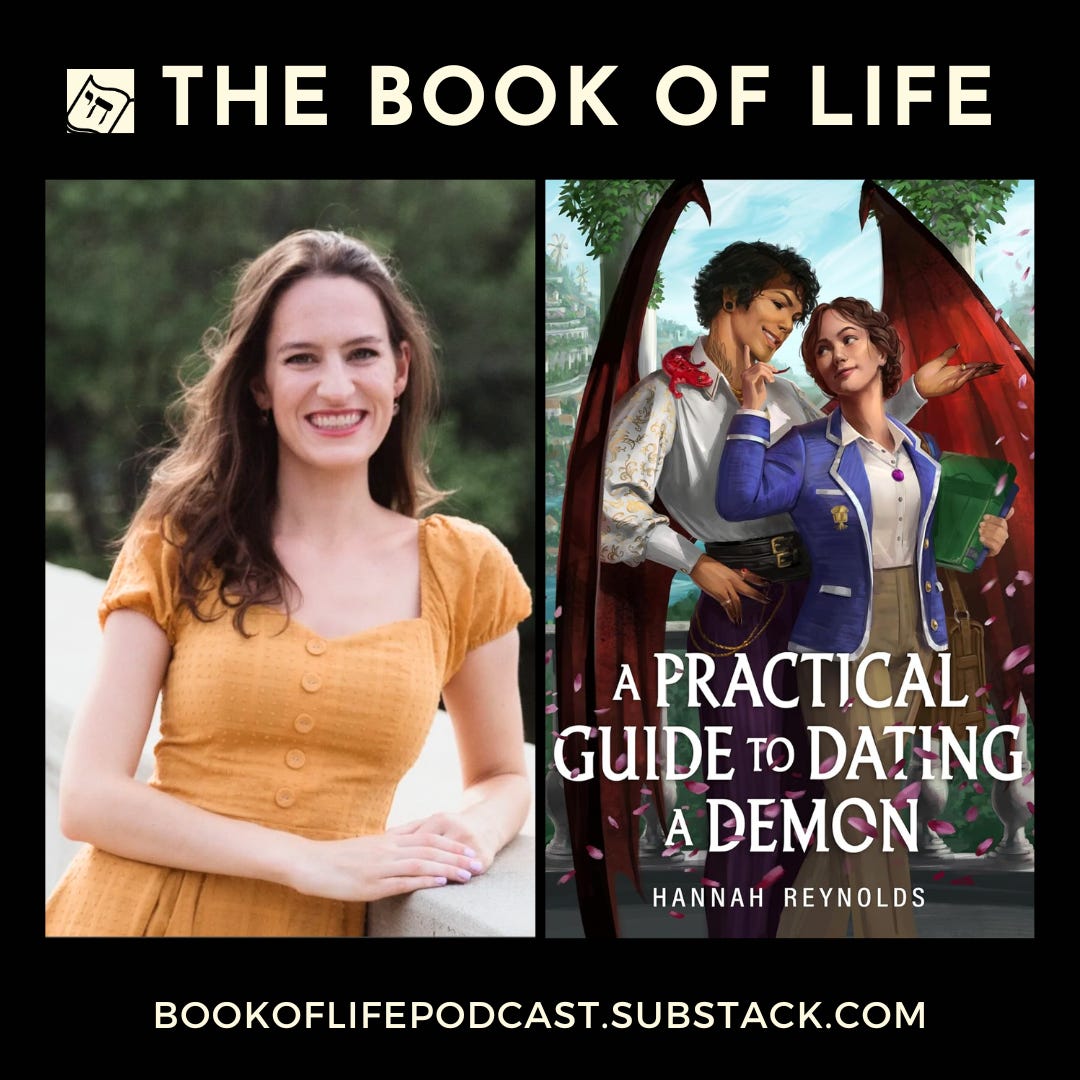
What better way to kick off pleasure reading season than with a fun Jewish romantasy? A Practical Guide to Dating a Demon offers a richly-imagined fantasy realm, a magic school, puzzles, quests, adventure, and of course, romance. When I got to the last page and realized it ends on a cliff-hanger, I was low key distraught! That’s why I had to call up author Hannah Reynolds to chat with her about this delightful romp, such a departure from her usual contemporary YA romances.
I also have to give Hannah credit for excellent use of Instagram in promoting her book. Check her account for clever posts like “5 days until A Practical Guide to Dating a Demon and 5 ways I was inspired by Provence, France” or “What’s Your Cozy Romantasy Book Title?”
Love, Heidi
NEWS
My “Jewish Joy” series continues on Multicultural Kid Blogs. Here’s my interview with past Book of Life guest Ana María Shua. READ HERE
CALLS TO ACTION
Jewish American Heritage Month is over but the education continues! Check out the curriculum offered by Noa Tishby (Israeli author and TV star) on Judaism, the Holocaust, Antisemitism, and the Land of Israel, for grades 6-12, at Eighteen Education. Great for use at any time of year! Tell all the teachers you know!
The Israeli Institute for Hebrew Literature has launched an online Book Club, with live interviews of Israeli and Jewish authors. The first meeting will be on Sunday, June 7 at 12:00PM ET and the theme will be “Coming to America: An Israeli in the US — in Literature and in Life” with host Jamie Dembo interviewing authors Tehila Hakimi and Joshua Cohen. REGISTER HERE
SHOW NOTES
BookBub (Hannah’s day job)
TRANSCRIPT
Note - If you are reading this in your email, you may need to click at the bottom where it says “[Message clipped] View entire message” to read the entire transcript.
Hannah Reynolds 0:00
[COLD OPEN] I’m like, this romance novel is medicinal. I’m like, you go read it, take it with your vitamin D, and you will be a happier human being. [LAUGHTER] You can just become happier by reading a book, ideally. You know, what an easy way to just improve your life.
Heidi Rabinowitz 0:16
Well, thank you for watching out for our health! Take two rom-coms and call me in the morning.
Heidi Rabinowitz 0:21
[MUSIC, INTRO] This is The Book of Life, a podcast about Jewish kidlit. I’m Heidi Rabinowitz. As the summer reading season begins, I’ve got a delightful beach read for you: a young adult romantasy called A Practical Guide to Dating a Demon by Hannah Reynolds. Hannah is already well known for contemporary YA romance, but she’s made a strong leap into the fantasy genre with this cozy, slow burn romantic adventure fantasy. Speaking of summer reading, check out the Jewish Book Garden’s Summer Reading Club, which offers lots of fun ways to enjoy Jewish kidlit. I will put a link in the show notes at BookOfLifePodcast.substack.com, where you can also find a transcript and bonus content. And don’t forget, if you’d like to hear Hannah’s Share Your Shelf segment, you can get access by upgrading to a paid subscription to support the show. Thanks! [END INTRO, MUSIC FADES]
Heidi Rabinowitz 1:27
Hannah Reynolds, welcome to The Book of Life!
Hannah Reynolds 1:30
Thanks, thanks for having me.
Heidi Rabinowitz 1:32
Hannah, I’ve always enjoyed your rom-coms, but A Practical Guide to Dating a Demon is something else. This is well researched and exciting, yet it’s cozy romantasy with a bit of a Hogwarts vibe. So, tell us about this book.
Hannah Reynolds 1:49
Well, first, thank you so much for reading both this one and all my other romantic comedies. This is about a girl who is attending a magical academy on a river island. She accidentally summons a demon. It is very different, because it is a fantasy world. There is a lot of magic, there’s magical creatures. The boy our main character falls in love with is a demon. But I do feel like at the heart of it, it’s also very similar to all my other books, in that it is both a romantic comedy -- the core of the story is just about the relationship between the two characters -- and as there always is in my books, the B line is, “and they solve a puzzle,” because I love puzzles! And so I think of it as a similar creation to the others, if shelved in a different area of the bookstore.
Heidi Rabinowitz 2:37
What was the inspiration for this book?
Hannah Reynolds 2:40
I had always wanted to write a fantasy novel. In fact, the first novels that I ever tried to write were fantasy novels. My dad read to me and my brother when we were very little. He would read us a chapter a night from Patricia C. Wrede, Lloyd Alexander, you know, Alice in Wonderland, and so that’s really what I cut my teeth on. But it turned out that was a harder sell in the publishing world, even though I signed with my agent with a fantasy novel -- it was a young adult retelling of Queen Esther -- but it never quite worked, so all of a sudden I had six contemporary novels published before we were really ready to send a fantasy novel out. So the genesis was just, like, I’d always wanted to do something like that. And then I’d had this sort of plot in the back of my head: what if a girl, you know, she didn’t have a boyfriend, she was maybe embarrassed or she needed an excuse, and she made up a boyfriend... you know, that sort of like “I have a girlfriend, she goes to school in Canada,” kind of thing, [LAUGHTER] but then what if that person showed up, and then you’re sort of caught in the middle of this lie where you don’t want to admit to people that you spun this elaborate web, and there’s this other person now claiming that they are your partner, and you’re like, oh, I don’t know. So then of course my twist was like, well, what if he’s a demon! That was sort of where the core plot of it came in in that way, and then everything else, I usually layer in after. I usually start with the initial meet cute or relationship between the couple, and then this book has also, there’s some ancient scrolls that need to be deciphered, there’s some mythology in there that you get to later on. But that was all layered in later on, as opposed to, you know, the initial genesis of the novel.
Heidi Rabinowitz 4:23
So you’ve actually been a fantasy writer hiding under the guise of a rom-com writer this whole time! [LAUGHTER]
Hannah Reynolds 4:32
That’s how I felt for years.
Heidi Rabinowitz 4:34
That’s very funny.
Hannah Reynolds 4:35
Yeah!
Heidi Rabinowitz 4:35
So Daziel the demon is our romantic lead, and Jewish demons are not at all like Christian demons. They’re not actually evil. In your opinion, is “demon” really the right translation for the Hebrew name Shaydim?
Hannah Reynolds 4:51
Oh, that’s such a good question. Not really. I’m no scholar, but I have a friend who is; she wrote her dissertation on Jewish demons. I talked to her a bit, and I read a lot of different articles, and I think, unsurprisingly, there’s no one straight answer when it comes to what is a shayd and what are demons. When you look it up, one of the things that people will call the shaydim, are maybe “the gods of foreigners,” is sort of one way of looking at it. I read a lot of different descriptions where they were bound by Jewish laws, they were actually part of the Jewish community in a strange way, but again, these are all different separate stories, so it leaves a lot of room for interpretation.
Heidi Rabinowitz 5:33
So, can you describe what are Jewish demons, what are shaydem, in folklore, and in your book?
Hannah Reynolds 5:40
In folklore, a lot of old scholars would say that they are everywhere. I can’t remember the exact numbers, but there’s thousands for every single person that exists. They are causing small bad things to happen to you, like acne to break out, or just like clogs in your sink, and so they’re just sort of like small and troublesome. They can gather a lot in your bathroom. They’re not necessarily super malicious, but they’re maybe not like very smart, and there’s tons of them. They’re invisible. One little thing I was able to include in the novel was: scatter ash on your floor, and if in the morning there’s chicken claw prints, that means demons have been there!
Hannah Reynolds 6:23
And then there’s also more human-like shaydim, where they do have human form, they can eat and drink, they are very intelligent, they can argue with people, they can be brought to court. You see one story where a shayd attacks local people going by for damaging his home, but they didn’t know he was there, so that who’s in the wrong? And then so he’s ordered to pay money to the people, so then you can see there’s this very human-like interaction going on. Then you have the king of the demons, demons who do become very powerful, very intellectual, maybe they study the Torah. There’s the story about King Solomon binds a demon with a ring, and he helps raise the temple, so that’s an incredible amount of power. But there’s nowhere that I could find, like, here’s seven different types of demons. What I found a lot of are like, some people think there’s three, some people think there’s seven, some people think there’s twelve. Again, many, many different answers for every single question that you could have.
Hannah Reynolds 7:21
While that didn’t give me a lot of structure, it did give me a lot of freedom in how I wanted to structure my world. So I decided in my world I would have both the high shaydim, sort of like court royal shaydim, who do appear like human, who are very powerful and can do many things. Then also wild shaydim, who are less powerful, a little bit more chaotic, much less human. That’s not really drawn from anything, that’s just from me sort of reading a lot of different source material and being like, all right, there’s no hard and fast rule, so I’m going to play with this a little bit and do what I think would be a fun world.
Heidi Rabinowitz 7:57
I love that, and I think that it’s very Jewish that there are a zillion answers...
Hannah Reynolds 8:01
Yeah, definitely.
Heidi Rabinowitz 8:03
...to the question. So, the world of this story is not actually explicitly Jewish, and yet it’s an entirely Jewish fantasy realm with really strong world building. So, can you talk about how you pulled that off?
Hannah Reynolds 8:17
You know, so many of the Jewish fantasy authors who I dearly love, a lot of their worlds are inspired by our world, and so a lot of the stories focus a little bit more on historical periods where we were dealing with trauma. All of the stories about the people who correspond to Jews in these novels, they’re often in ghettos, they’re often under attack, and I didn’t really want to tell that story. That was just not the one that I was interested in. Here, I just wanted to make the entire world Jewish, and basically everyone in this world is pretty Jewish, and so everything is incredibly normalized, and no one is standing out because they’re Jewish. Nobody is feeling othered, that’s simply the way of life for everybody, including for the demons. So, the demons also have rabbis, and there are specific things like a mezuzah that is against demons. It’s like blowing the shofar, that’s supposed to banish some demons too. So, those kind of things from the medieval era, it’s about how to protect yourself from demons. They show up there a lot, so I think I just decided that the baseline standard was everyone was a little bit Jewish, so that was very fun. But again, not based on any specific time and place, except Provence, a little bit in France: the terrain, the flowers, the winds, those are all very much a part of southern France, and that has nothing to do with Judaism. I just love France, so that’s just sort of the style.
Heidi Rabinowitz 9:52
Well, that makes sense. You take different bits and pieces and bind them together... which is kind of like the magic that they do!
Heidi Rabinowitz 9:59
The magical creature, the Ziz, is an important part of this book, and I was somewhat familiar with this creature because of the 2001 picture book, The Hardest Word: A Yom Kippur Story by Jacqueline Jules. But tell us more about the Ziz.
Hannah Reynolds 10:14
Sure, so I was very familiar with the Behemoth and the Leviathan, and I didn’t actually know that there was a third great beast in that trio, which is the Ziz. And the Ziz is the ruler of the sky, the birds. There’s a lot of very interesting stories about it. It’s massive, first of all, you know, it has a wingspan big enough to block off the sun. If it stood in the ocean, the ocean only comes up to its ankles. You know, once it dropped an egg, and the egg flooded cities. So you know these really interesting stories of a beast. Not very many pictures of what it’s supposed to look like, but it is sort of a griffin-like creature, if you will. A ziz itself, I believe, means a little of this, a little of that, which is what this is, is supposed to taste like.
Heidi Rabinowitz 11:03
Taste like!?
Hannah Reynolds 11:05
Yes! Taste like at the feast that is to be served to everyone at some point.
Heidi Rabinowitz 11:10
When I read about it in the story, it sounded like it was important to help balance the world, so I’m surprised that anybody would want to hunt and eat it.
Hannah Reynolds 11:20
Ah, yes, that, that didn’t make it into my version, that’s that’s more from Jewish lore’s version. In my world, nobody’s trying to eat the Ziz at all. That was me, perhaps cherry picking a little bit of what part of mythology I wanted to include. I did add my own things to it, you know. In mythology, I don’t think that these creatures die or have children, but in my version, I decide that they could all depend on each other, and there could be a cycle of life and death for them.
Heidi Rabinowitz 11:51
Okay, well, it was a well-evoked magical creature.
Heidi Rabinowitz 11:56
Words are very important in this world, and carving words on objects is a way of casting spells, and this seemed like a very Jewish concept that words can change reality. So, can you talk about that?
Hannah Reynolds 12:07
Yeah, yeah, I have always thought about how much work it must be to do magic, and I wanted it to be something that is a lot of work, but is also accessible to anyone who is interested in it. So, a lot of fantasy novels, you have somebody who is very special, you know, they are lucky to have these amazing powers, there may be one in a million. And I wanted this to be a story where really anyone could do magic if they worked hard enough at it. Maybe you don’t want to do it, because you do have to learn how to write a spell, and you do have to try over and over again. I thought of it very much like coding, actually, where you’re just constantly trying it and being like, “Oh, did that work? And you’re like, “It actually didn’t. Let’s go back to the drawing board and try it another time.” That was sort of how I built my system.
Hannah Reynolds 12:54
And then, yes, I just think words are so important. They have so much weight, and people aren’t always as careful with them as I think we could all be. People also have different definitions sometimes for the same words. A really easy way I think to get in an argument with somebody is because you maybe are trying to say the same thing but you disagree on the meaning of the words that you’re using, and so I think it can be very important to define things in the first place, so you really understand what you’re both talking about. And so I think I’ve always just cared a lot about language, and so that makes its way into my books.
Heidi Rabinowitz 13:37
Tell us about something really interesting that you learned in your research for this book, something you were able to use, and maybe also something that ended up on the cutting room floor.
Hannah Reynolds 13:46
Oh, that’s so interesting. The first thing that I can think of that ended up in the cutting room floor: Paz is this little magical salamander friend that Daziel has. He sits on Daziel’s shoulder, he made it to the cover, he’s just like fun and friendly. But in the very first version of this, when I was reading up on magical salamanders, I read that they are created by being burned in these magical fires for seven years, and then almost as soon as they’re born, someone kills them -- they might have eaten them, or they like use their blood -- and then they are immune to fire. That I actually had in the very first version. Daziel meets Naomi, the heroine, and to prove that he is a demon, he has her eat the salamander, also to protect her, which you don’t find out till later. And then, then the salamander is fine, he like pops back into existence, but then she’s immune to fire after that. And then I had a lot more fire going on in the story [LAUGHTER] that had to tie back into how shaydim are born of fire and ash. And that all got chopped, that was a little bit too much, I think, and a little more action-oriented than the book actually ended up going.
Hannah Reynolds 15:00
Like, another fun one that did stay in was this myth about having red string tied around your wrist, and this shows up in Jewish culture, but actually also in a lot of different cultures around the world. Part of this bracelet is protective against demons, but then one thing that I found out in one of these Jewish folklores that I was reading, was that if it fell off it meant that you had just met your husband. And so I kept that in, and Naomi, she wears her bracelet, and it falls off as soon as she meets Daziel.
Hannah Reynolds 15:31
I thought it was pretty interesting, because I realized that if you’re not familiar with Jewish mythology as a reader, you’re not going to recognize any of these as Jewish, so I’ve actually had a lot of readers who didn’t realize that any of these were sort of like call outs. I think a lot of Jewish audiences read this book and can immediately tell that there’s a lot of Jewish mythology in here, and other readers who are less familiar actually don’t recognize where it all comes from.
Heidi Rabinowitz 15:58
Yeah, that makes sense to me. It’s an extremely Jewish book, but because it’s not laid out explicitly, somebody without that knowledge could definitely just read it as a straight fantasy and not realize where all this is coming from.
Hannah Reynolds 16:10
Yeah.
Heidi Rabinowitz 16:11
When I got to the end of the book and I found out it ends on a cliffhanger, I freaked out!
Hannah Reynolds 16:16
Oh no, I’m sorry. [LAUGHTER]
Heidi Rabinowitz 16:20
So I hope it’s the first in a series?
Hannah Reynolds 16:23
Yes! Just to be very frank, authors don’t really have control over publishing schedules. So I had written this book with the intention of it being part of duology. I think that is very clearly set up for a second book. So my publisher cares about sales, right? So that’s simply how the business works. They’ll publish the second book if there’s enough sales for the first book. If there aren’t, then I will probably end up distributing it myself. If I had thought that this was the only book being published, I never would have ended it on such a clear division between the first half of the story and the clear intended second half.
Heidi Rabinowitz 17:01
So it’s interesting that you’re saying that it’s a duology, because I was figuring it would be a trilogy. Now that you focused on the Ziz, I thought there should be a book about the Behemoth and a book about the Leviathan. But no, it’s not structured that way?
Hannah Reynolds 17:14
In my head, it was always going to be: Daziel is in Naomi’s world, the human world, for the first book, and then the second book, she is in his world, where she goes with him for the summer to live at his court, and be like, okay, would I be interested in living in this world? And the first book, very much, you know, the initial stages of a romance, and the second book, a lot more of a “now we are in a relationship, and how does that work?” especially because they’re so young, you know, they’re 18, 19 years old, and they’re still figuring out what a first relationship is like. So that was my structure of it. Having actually heard that, and the Behemoth is bigger in the second one, I’m like, oh, maybe eventually there could be a third one as well.
Heidi Rabinowitz 17:57
The more the merrier, I think, because I really enjoyed it.
Hannah Reynolds 18:00
Oh, thank you.
Heidi Rabinowitz 18:01
And so, how can we, as listeners and readers and fans, help make that happen? So, obviously, we should run out and buy the book. Is there anything else that we can do to make this a reality?
Hannah Reynolds 18:12
The best way is to leave reviews on your platform of choice and to tell your friends about it. I don’t know, it’s not on the readers. I hate for it to be on anybody’s shoulders. So, I’m just like, the second story is coming, you know? And I would love for it to be with my publisher, but if I have to self-publish it, I... I would never abandon a story halfway through. I just feel like that’s, that’s not the done thing, really, [LAUGHTER] or it’s not what I want to do. But reviews are always very helpful.
Heidi Rabinowitz 18:42
That’s a relief. Because I was definitely left hanging. I wanted more!
Heidi Rabinowitz 18:47
On Instagram, you posted a video about how little power an author actually has over the title of a book, and A Practical Guide to Dating a Demon is a charming title; as you said in your video, it captures a whimsical vibe. But it wasn’t your top choice, and really the book is not a practical guide at all. So, can you tell us what your own original top choice for a title was?
Hannah Reynolds 19:10
Yeah, so when I’m writing a book, all of my Word documents are all labeled the POV character’s story. So, this was called Naomi’s Story the whole way through. When I talked about it with my friends, I called it the Demon Book. When I talk about the sequel with people, I call it Demon Two. Oh, and then we called it The Demon’s Betrothed for a long, long time. That was the working title. We must have gone back and forth with my publisher about the title, about 30 different titles. I think the one that I really liked had Winds in it, because you know, there are a lot of winds in this book. There’s also trends in titles, and marketing weighs in on titles a lot, definitely more, I would say, than the author does. I like this one too, but again, it’s not really a guide to anything. So what I sort of learned at this point when to pick my battles, and this was not a battle that I cared as much about, so I was like, okay, that’s cute. But my working title for the second book, which is also not a guide, is A Whimsical Guide to Marrying a Demon, because I did sort of like the format.
Heidi Rabinowitz 20:22
It is a hook.
Heidi Rabinowitz 20:23
Can you recommend any read-alikes for A Practical Guide to Dating a Demon, especially any Jewish read-alikes?
Hannah Reynolds 20:31
I can’t think of other Jewish cozy fantasy. That isn’t to say they don’t exist, I am sure they exist. There’s definitely lots of Jewish fantasy now, like Rena Rosner, Sacha Lamb, Ariel Kaplan, AR Vishny, Allison Saft. Allison Saft is actually a little bit cozy, but she’s not always Jewish. It depends, like, which of her book. Naomi Novik, I think; I would never dare compare myself to Naomi Novik, but Spinning Silver is a very Jewish fantasy, not cozy, but I really enjoyed how Jewish that was, and how much of a romantic fantasy that was. But what I was really thinking of was the romantic fantasy novels that I read as a child, as opposed to the romantasy that is out now, which I think is a little bit sexier, a little bit more focused on the romance. I really think of mine as one where it’s really 50% romance, but there’s a whole other plot line, and if you just want romance, I think you might be a little disappointed. Growing up, I read a lot of Sherwood Smith, Diana Wynne Jones, Patricia C. Wrede, Tamora Pierce - these authors were the ones that I was pulling on, sort of these childhood favorite authors.
Heidi Rabinowitz 21:49
Thank you for those recommendations. I definitely think that Night Owls by A.R. Vishny would be a good match. I think it is somewhat cozy and does have sort of a puzzle that needs to be solved, so I think that would be a pretty good read alike.
Hannah Reynolds 22:03
Yeah.
Heidi Rabinowitz 22:04
In a 2021 article in Kirkus, you were quoted as saying “young adult fiction and romance go hand in hand, because I think of them both as genres of optimism.” So, can you talk some more about that?
Hannah Reynolds 22:17
Yeah, I think that a lot of contemporary fiction, especially when you’re reading a lot more literary fiction, you know it’s grappling with what we’re all grappling with day to day, and that can be very depressing. And as an artist, it can be very fulfilling to write work that is very depressing for a variety of reasons, [LAUGHTER] you know, you’re like, oh, I really nailed that one! But I think both YA and romance are very actively choosing to be optimistic, and that is because it’s a really important thing that people need in our lives. I recently was talking to a school about the power of reading uplifting fiction. I did a lot of research. You know, I was like, Oh, I’m gonna go talk to the school. They’re from 7th grade to 12th grade. For some reason, I was really convinced that the teenagers would not believe me if I didn’t come armed with a lot of facts. But what I really find is that you’re gonna live a lot longer if you’re a happier person, and laughter, in particular, has a lot of huge benefits. It de-stresses you, it decreases anxiety, it can decrease depression. There’s actually some interesting studies about how laughter can improve your memory, and being happy, of course, also is very good for your health, and can lower a lot of bad health risks. And so what these books are doing is they’re actually just making you a happier person, which can make you a healthier person, especially I think for teenagers that is wildly important because they can be so stressed, but I think also everybody is so stressed. I’m like, this romance novel is medicinal, I’m like, you go read it, take it with your vitamin D, and you will be a happier human being. And so I just really believe that makes such a huge difference in your life. And so if you can just become happier by reading a book, ideally, you know, what an easy way to just improve your life.
Heidi Rabinowitz 24:18
Well, thank you for watching out for our health! Take two rom-coms and call me in the morning. [LAUGHTER] Yeah, I love that.
Heidi Rabinowitz 24:27
So, up until now, you’ve written realistic contemporary rom-coms, and I’ve always enjoyed your Nantucket-based stories about that large Sephardic family, the Barbanels and the Golden Door series. So, tell us a little bit about this series, and are there any more entries forthcoming?
Hannah Reynolds 24:43
There’s about 12 cousins, and I could see a story for all of the cousins. They all have their own distinct personalities. A shy cousin was up next, and then some rambunctious triplets. That is my publisher’s decision, whether or not they wanted more. I would love to write more. And what I would actually really love to do for that world is to write some of the adult stories. The mystery that the teenagers are solving is often about, like, oh, and here’s this woman who, in the 1800s disguised herself as a man and fell in love with a sailor on a ship and went traveling the world, and also here’s a through line about the Nantucket whaling industry. [LAUGHTER] So, I would love to write that historical novel. I deeply love historical fiction, so I’d love to write some of those about the Barbanels.
Heidi Rabinowitz 25:34
You have another series of rom-coms for adults called the New York Leopards series, involving members of a football team called the Leopards, and this also has Jewish representation. I’ve never read them, because they’re not kids books. I don’t even have time to read adult books!
Hannah Reynolds 25:49
That’s really fair.
Heidi Rabinowitz 25:50
But can you tell us about this series?
Hannah Reynolds 25:53
So, these are the first books I ever wrote. I wrote these books when I was very young, like 22 and 23, about being 22 and 23. I did recently get the rights back to them from Harlequin and self-published them, which is a whole, a whole experience. I have so much respect for people who learned the self-publishing industry. The heroine of the first book, Rachel, is Jewish, and her partner is Irish Catholic, and it’s a real clashing of their two worlds. It was fairly early, it was 2013. There weren’t a lot of traditionally published Jewish books out there, and I got a little bit more attention for it than I was expecting, which sort of startled me. And then the second book I really dialed back, and I was like, oh, there’s no Jews in this book, because I didn’t really want any attention. But I got many letters from people who said that they wanted this book about one of the boys on the football team who was Jewish. And I had never actually intended to write about him. He had sort of been an entrance point for the heroine of the first book to befriend this team, because this boy sort of attached himself to her, and he was like, Hello, please be my friend. So then I went, and I wrote a book about him and his childhood best friend, Tamar. It was a very early romance novel where both leads were Jewish, and it’s been like really, really nice how much it touched people.
Heidi Rabinowitz 27:18
It’s interesting that they made more impact than you expected them to.
Hannah Reynolds 27:24
I had never considered writing about the Jewish experience. I was just writing about my experience. I had never published a book before, so I didn’t really understand what reception was like.
Heidi Rabinowitz 27:36
It’s Tikkun Olam time. So, what action would you like to call listeners to take to help heal the world?
Hannah Reynolds 27:43
So many people can feel burned out by everything that is going on right now. So I would just like to encourage people to do smaller actions, which perhaps feel easier, like maybe you can do a bystander training; here in Massachusetts we have a great one with hotlines for if you see ICE around in your neighborhood. I think a lot of states have similar trainings that you can do. There’s a lot of things that you can do around the election period, just to make sure that people are able to vote; there’s a lot of voter suppression going on right now. So I think that just anything that you can do that feels within your wheelhouse, like that, you know, I think is really a great way to stand up and give back to the community.
Heidi Rabinowitz 28:27
Thank you very much. Is there an interview question you never get asked that you would like to answer?
Hannah Reynolds 28:32
Well, it’s a really silly one, but one question that I like to ask people is, is there anything sort of silly going on in your book, like a little secret treat or something? And so, in my book, it’s that palindromes saved the day. My name, Hannah, is a palindrome, and my whole life people have liked to remind me of that fact, in case I somehow forgot. [LAUGHTER] And in this book, the word Ziz is also a palindrome, and the fact that it’s a palindrome is sort of like a huzzah moment for everybody. So that’s very, very silly, but it’s something that made me personally very happy, and I feel like that’s the fun thing about being a writer is that you get to crack yourself up and like have fun with yourself all day long, and that’s sort of what I feel like the point of creating art is. Yeah, that made me very happy. That’s my silly little one.
Heidi Rabinowitz 29:28
Well, I love that, and it’s not even that silly, because they’re trying to translate a lost language, and so being able to spot a palindrome really helps them crack that code. So, it’s, it’s actually important, it’s not just silly!
Heidi Rabinowitz 29:41
Where can listeners learn more about your work?
Hannah Reynolds 29:46
You can follow me on Instagram at @HannahElisaWren. Unfortunately, it is all too complicated to find, because it’s Elisa with an s and Wren like the bird. But you can also just go to my website at HannahReynolds.net which has links to all of my books, all of my social medias, and more information there.
Heidi Rabinowitz 30:09
Hannah, we’re going to talk about your personal library now to see what book you’ll be sharing from your own shelf, so anyone who wants to hear about your pick can become a paid listener on Substack to get access to the Share Your Shelf segments, but in the meantime: Hannah Reynolds, thank you so much for speaking with me today. Such a pleasure!
Hannah Reynolds 30:28
Thank you for having me.
Leila Sales 30:33
[MUSIC, DEDICATION] Hi, this is Leila Sales, the Editorial Director at Kar-Ben Publishing. I’ll be joining you soon on The Book of Life podcast, and I’d like to dedicate my episode to my mother, because I’m obsessed with her. She’s the cleverest person I know. She is endlessly entertaining and endlessly entertained by everything in the world. She has the best sense of humor. She’s fascinated by Jewish religion and culture. She’s just my role model.
Heidi Rabinowitz 31:11
[MUSIC, OUTRO] Say hi to Heidi at 561-206-2473, or bookoflifepodcast@gmail.com. I’d love to hear from you! Subscribe for free to BookOfLifePodcast.Substack.com to get show notes, transcripts, Jewish kidlit news and calls to action right in your inbox. If you’d like to receive the bonus Share Your Shelf segments, you can upgrade to a paid subscription. The Book of Life is also on Facebook, Instagram, YouTube, and our 20-year back catalog is online at BookOfLifePodcast.com. Want to read the books featured on the show? Buy them through bookshop.org/shop/bookoflife to support the podcast and independent bookstores at the same time. The Book of Life is sponsored by the Association of Jewish Libraries, the leading authority on Judaic librarianship. Learn more at JewishLibraries.org. Additional support comes from Congregation B’nai Israel of Boca Raton, Florida At CbiBoca.org, AJL also sponsors our sister podcast, Nice Jewish Books, a show about Jewish fiction for adults. Stick around past these credits and you might hear a promo for the latest episode of Nice Jewish Books! Our theme music is provided by the Freilachmakers Klezmer String Band. Thanks for listening and happy reading! [END MUSIC]
[MUSIC, PROMO] It is 1918 and Bluma has waited four long years for her husband, Sender, to bring her and their three daughters from Romania to America. When the tickets fail to arrive, she takes their fortune into her own hands.
Packing up her children, Bluma journeys across the ocean to rural Ohio—only to discover a crumbling farmhouse, a failing farm on the brink of foreclosure, and a husband more interested in studying Talmud than in actual farm work. In a strange new country, can she protect her dreams for her daughters: education, independence, and marriages built on love?
Join me for a conversation with author Miriam Flock about her powerful novel, Wild Grapes, on the Nice Jewish Books podcast. [MUSIC FADES]